Tag: writing as spiritual practice

  • React or Respond: A Choose Your Own Adventure

    React or Respond: A Choose Your Own Adventure

    So you’re at the sink, washing up the breakfast dishes when a writing idea pops into your head. It’s brilliant; it blazes through your body. Do you:

    A) Dismiss it because you can’t do it justice,
    B) Disregard it because the world’s on fire and there are more important things to do, or
    C) Heed it and head to the writing desk?

    Because you like to write, let’s assume you choose C. You carry a mug of hot liquid to your desk, where you take out notebook. You uncap your favorite pen. You gaze out the window. Do you:

    A) Panic at the blank page and decide this isn’t worth it,
    B) Form words carefully inside before writing them down, or
    C) Blather on the page in hopes you’ll find your way?

    Let’s pretend it’s a good day and you chose B or C. An hour passes, leaving you with a draft. Before you head off to your job, you read it over. Do you:

    A) Crumple it up and feel miserable because you’ve done a disservice to your idea, you’ve used clichés, your word choices are pedantic, and you really should give up writing,
    B) Inflate with pride because it’s amazing and everyone will now recognize what a genius you are, or
    C) Feel grateful for your quiet hour, acknowledge your writing’s flaws and gifts, and look forward to tomorrow?

    I could go on, leading you through drafting, revising, and releasing, but let’s stop here. In every moment we face a choice: Do I react or do I respond? Reactions are impulsive, fast, egoic, and emotional. Think of chemicals coming into contact—reactions are a flash opposition to a circumstance. 

    The word respond, on the other hand, means to make an answer. Responses are considered and slow. Pure response emerges from our best self, passes through our thoughts and feelings, and becomes a deliberate choice. Reactions come easy while responses always demand something. They’re hard.

    I like distinguishing between these two because my writing is damaged when I’m reactive and flourishes when I’m responsive. I’d even go so far as to say reactivity can’t be creative; it’s too controlled by circumstance and impulse. Responsivity is inherently creative because it draws from our deepest well. We can be in dialogue with inspiration, the call and response taking form on the page.

    This is why I have such faith in writing as a spiritual practice. The literary craft conditions us to be responsive—to our creative urges, to the challenging realities of the creative process, to our audience. In an age where reactivity runs rampant, I invite you into a measured practice of response, on the page and in life.

    —Elizabeth Jarrett Andrew

    Photo by Kelly Moon on Unsplash

    Appreciate these reflections? Move the gift forward with a contribution to the Eye of the Heart’s writing programs. Your generosity keeps the Gifts of Writing Micro-course and ongoing online community free to everyone. Give here!
  • Creative Bypassing:  Grist for the Mill

    Creative Bypassing:  Grist for the Mill

    I’d like to make a confession.

    On Sunday mornings, I sit in church internally spinning out a reactive, biting critique of the service, how hollow and performative it is, how the sermons charge us to do justice and love kindness and walk humbly without ever addressing how, feeling mightily superior about the vibrancy of my prayer life and a tad resentful that other folks in the pews don’t recognize this. Valid as my criticisms may be, this inclination to nurse my wounds with “holier than thou” thoughts is, well, shameful. It’s a form of spiritual bypassing, a trap those of us walking transformational paths tend to stumble into. Flamboyantly. Embarrassingly.

    The term “spiritual bypassing” was coined by John Welwood, a Buddhist teacher and psychotherapist, when he noticed clients avoiding painful emotions by seeking refuge in spiritual ideas or practices. Rather than feeling grief that the beloved institution of my faith is faulty and dying, rather than getting angry that the beautiful mystical dimension of Christianity is so misunderstood, rather than experiencing the swelling loneliness of a committed transformational path, I take refuge in superiority. My fantasy keeps me safe, isolated, and stagnant.

    To be completely honest, part of the reason I keep going to church is how humiliating these internal reactions are. I don’t like them. Maybe if for an hour each week I face these weaknesses, I can stop bypassing and finally walk the walk.

    Creative folks have our own version of bypassing. As soon as pen hits the page, writers’ thoughts leap ahead to publication, with its kudos and condemnation. We imagine the inspiration we’ll bestow upon our readers and the benefits our work will impart to society. If we don’t spin out far-flung fantasies of fame, we console ourselves by assuming others will at least validate our worth. By taking refuge in our beloved image of fulfilled creativity, we skillfully avoid whatever hard work presents itself: the effort of validating our own worth; the arduous process of showing up in our creations; the painful need to face our smallness; the exercise of faith to proceed regardless.

    Writing, like spiritual growth, takes time and effort. When we leap over the process to the product, we bypass art. In the meantime, we can be grateful that the process makes us aware of our propensity for bypassing. Once we see it, it can become, as a former therapist often told me, more “grist for the mill.”

    —Elizabeth Jarrett Andrew

    Appreciate these reflections? Move the gift forward with a contribution to the Eye of the Heart’s writing programs. Your generosity helps keep the Gifts of Writing Micro-course and ongoing online community free to everyone. Give here!

    Photo by falco from pixabay

  • This Queer Divine Dissatisfaction

    This Queer Divine Dissatisfaction

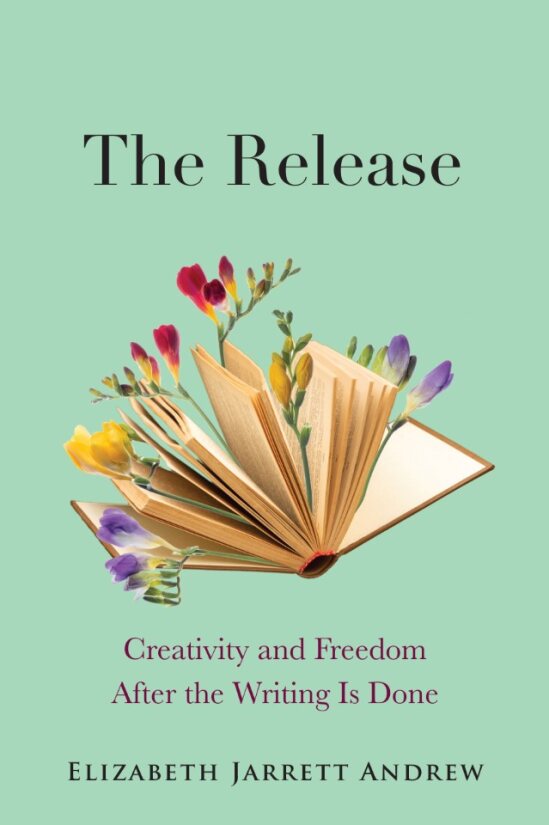
    In preparing to launch The Release this October, I’m dizzied by the ironies of releasing a book about releasing creative work. If ever there were an opportunity to heed my own advice! So between now and then I thought I’d share some excerpts, in part to give you a foretaste but mostly to remind myself. The Release shares spiritual practices to help writers stay grounded and creative after a project is done. Goodness knows, that’s exactly what I need now.

    Here’s a passage from an early chapter on hazards during the release:

    Sadly, the exhilaration we feel on finishing a project too often crashes into what Charles Salzberg called “postwritum depression.” We’ve left behind the encompassing, cherished world we’ve engendered as well as our established patterns for entering it. If we’re fortunate enough to publish, our initial elation is frequently followed by insecurity and emptiness. After memoirist Jessica Berger Gross’s euphoric book launch and tour, she reflected, “I felt despondent. Rudderless. Tired. Inexplicably, I felt like a failure. Rather than feeling gratitude for what had happened, I obsessed over what hadn’t. I judged myself for the brass rings I hadn’t grabbed.” She titled her essay about this disappointment, “I Just Published a Book: Why Am I Depressed?” I remember Mark Doty describing the high of receiving an NEA grant followed by three days of punishing self-doubt. Harper Lee was a hundred pages into her next novel when the success of To Kill a Mockingbird disrupted her permanently. “When you’re at the top,” she told her cousin, “there’s only one way to go.” For an up-and-coming author, the blessing of a multi-book contract becomes a curse as soon as the weighty expectations of publisher and public enter the writing studio. As musician and performance artist Amanda Palmer says in The Art of Asking, “Outside approval can make The Fraud Police louder: it’s more like fighting them in high court instead of in a back alley with your fists.” 

    The trouble is, no external results will quench our longing. No one can validate our creative efforts. No kudos can assure us we’ve “arrived.” Martha Graham biographer Agnes de Mille tells of a conversation that’s worth relating here. Herself a choreographer, De Mille was dispirited; she believed her best work had been ignored by critics while her work on Oklahoma!, which she felt was only “fairly good,” was a “flamboyant” success. De Mille told Graham that she saw only her work’s “ineptitude, inorganic flaws, and crudities.” 

    “I am not pleased or satisfied,” she said.

    “No artist is pleased,” Graham retorted.

    “But then there is no satisfaction?”

    “No satisfaction whatever at any time,” Graham said. “There is only a queer divine dissatisfaction, a blessed unrest that keeps us marching and makes us more alive than the others.”

    Nothing—not publication, not great sales numbers, not stature, not being able to pay the bills, not even readers’ gratitude or public conversations with presidents or being anthologized—will make this “queer divine dissatisfaction,” this “blessed unrest,” go away. Why? Because creative longing is a fundamental part of (I’d argue) everyone’s humanity. It is right and good. It fuels us. It urges us to seek union. At its core, this longing is holy. Only when we attach it to specific outcomes does it become destructive.

    There will be no ultimate validation of our creative efforts, no conclusive satisfaction. When we enter the release looking to satiate our longing, we tilt at windmills. “The only real cure for post book depression?” writes Berger Gross; “Start writing something new.” Creative fulfillment comes from creative engagement. That’s it. For artists, creativity is our means and our ends.

    – Elizabeth Jarrett Andrew

  • Last Regrets

    Last Regrets

    On a weekly basis, one client or another will tell me, “If I wind up on my deathbed without finishing this project, I’m seriously going to regret it.” This population of writers is, admittedly, peculiar; they share an intense enough degree of passion, compulsion, or vocation about writing to pay me good money. Or perhaps they seek me out because they sense in me a similar drive. My current projects, a grandiose credo articulating once and for all my metaphysics and a middle grade novel about a puppet theater, I care about with mama-bear furiosity. Were death imminent, along with cherishing my dear ones, soaking up the natural world, and consuming chocolate with abandon, I’d plug away at these projects.

    Why? What is so important about creative work?

    When I was in my twenties drafting Swinging on the Garden Gate, I would have said I wanted evidence of my existence to outlast me. A published book would become my legacy—a means for my personhood to continue. 

    Now that the memoir has circulated for twenty-plus years, this reason has faded. The book itself is just an object. Sure, it comes alive when it moves a reader, but my desire to effect change like that, while certainly real, isn’t strong enough to warrant deathbed regret.

    I also would have said that writing my story allowed my otherwise hidden internal life to become evident on the page. Before I died I wanted to be known, not in the sense of being famous but rather being seen by others in the full complexity of my personhood. Amazingly, the book did that and more: It helped me manifest more completely that rich complexity in my life. I came out bisexual and as a spiritual human being, to myself as to others. The book birthed me. On some unconscious level, did longing for that transformation drive me to write?

    These days I know that who I become for having written is as significant a contribution as any product that goes out into the world. I suspect that need to finish my credo and that middle grade novel because both contain some essence of life I’m eager to meet. At the end of my days, perhaps fulfillment will come not just from leaving my unique fingerprint on creation but from growing as much as I possibly can into that unique selfhood. Writing is my means.

    – Elizabeth Jarrett Andrew

    Photo by John Thomas on Unsplash

  • Celebration on the Altar of the World

    Celebration on the Altar of the World

    Well, friends, my decades-long obsession with revision has reached a new extreme. I’ve shamelessly messed with another author’s work. Is this even allowed?

    When my mother died, her study group was preparing to read Teilhard’s Divine Milieu. I picked up her beat-up paperback copy just as I began a two-year formation program in contemplative Christianity. One day my teachers used the beginning paragraphs of Teilhard’s Mass on the World to open a period of silent prayer. Soaring language, earthy reverence, our group’s collective yearning, and the potency of my mother’s spiritual legacy washed through me; I couldn’t stop weeping. Never before had liturgy touched me so deeply.

    Teilhard de Chardin was a scientist, paleontologist, philosopher, and Jesuit priest; born in France in 1881, he served as a stretcher-bearer during WWI and over the course of his career taught and conducted research in England, Egypt, China, and the U.S. He participated in the discovery of Peking Man. But at heart he was a mystic, and his sweeping recognition of divine unfolding within evolution was so radical, church authorities in Rome forbade him to teach theology, banned his books, and banished him to China. Teilhard’s vision, that matter is spiritually potent and evolution a progression toward consciousness, is to this day treated by mainstream Christianity with skepticism.

    I think it’s brilliant.

    When Teilhard was serving in the trenches, unable to celebrate a traditional Mass for lack of bread and wine, he instead said “a Mass on all things,” lifting himself up “beyond these symbols, up to the pure majesty of the real itself.” He made the whole earth his altar on which he placed the “labors and sufferings of the world.” Years later, on an expedition on the Yellow River, he again took up the practice and wrote The Mass on the World. Teilhard had the audacity to revise the Catholic Mass—even worse, to reimagine Christ’s body and blood as evolving earth and suffering humanity. No wonder his work was censored. 

    Even so, my experience of Teilhard’s personal Mass was so tremendous, I felt baffled that no one ever used it. So I read it in full—and found it heady, verbose, disorganized, patriarchal, and way too long. What?! No wonder my teachers read only a few paragraphs. That’s when my revision fingers started itching. Could I re-render the liturgy, lending it economy, flow, inclusivity and functionality while preserving Teilhard’s soaring language and incarnational theology? Better yet, could I layer in my own reverence for the divine feminine principle within creation? I imagined myself as a translator, making accessible to contemporary (and often disenfranchised) Christians a dimension of our mystical heritage that too often remains hidden.

    The project has been unlike anything I’ve done before. Rewriting someone else’s prose is an audacious exercise, especially if its author was a brilliant mystic. But I figure Teilhard would approve. We’re both revising the tradition we’ve inherited to more fully praise the life and light infusing creation, here and now, with what we’re been given. Not only that:  By practicing revision, we become active agents of creation’s unfolding. Teilhard would say that’s what we humans were made for.

    – Elizabeth Jarrett Andrew

    PS: You’re invited to experience this Celebration with us at Eye of the Heart Center’s upcoming sunrise event:

  • Flourishing in Creativity’s Gift Economy

    Flourishing in Creativity’s Gift Economy

    A few years ago I submitted an essay to an anthology of queer Minnesotan writing. I called it “Wearing Bi-Focals” because it explored bisexuality as a lens much as my progressive lenses help my eyes integrate what’s near with what’s far. I sent the essay out and promptly forgot about it.

    Six months later the editor called me. He liked the piece and would include it. (I did a little internal gig.) In the meantime, might he quote from it? His Baptist congregation was soliciting themes to guide worship during the next year and he wanted to suggest the idea of nonduality. Could he use my words as an illustration?

    I was struck by how my sentences acted like flint and steel, igniting a small spark. They worked, both in the sense of being artful and in the practical sense of moving a reader. Perhaps they undergirded a year of worshipful exploration, the spark passing subtly and silently through the congregation. Or perhaps not. Likely I’ll never know.

    I wrote those sentences but I didn’t generate that spark. I created the conditions that made the spark possible. The spark—the essay’s gift—came to me as an inspiration; it arrived as desire spurring me to write and as the talent and energy I brought to the task. The gift changed me, and I showed my gratitude with labor. Finally I passed it along. Now the essay has its own life, its own agency.

    More subtle and powerful than the essay itself, however, are the ways writing it made me conscious of my own dualistic, us-versus-them thinking. Today my glasses remind me that there are always multiple ways of seeing. Whenever I actively hold paradox in my interactions with others, striving to see from multiple angles, the essay’s pilot light reignites. The living quality of my writing has a counterpart inside me.

    These days I’m increasingly convinced that creativity flourishes within a vast gift economy. If we’re faithful to that spark of inspiration, tending it, feeding it, and moving it into our relationships—with or without the product reaching an audience—we thrive, both as writers and as humans.

    The gift is a spark of life. What if we pay attention to that spark rather than setting our sights on some end product?

    But keeping our focus on the gift is hard in a market economy, where end-product is all. We need the company of others who share this practice. That’s why I’m excited to invite you into a new—free—micro-course I’ve put together that introduces the gift in writing and ushers you into a community of writers seeking to nurture the gift. This is Eye of the Heart’s first step into creating community online. I hope to share the gift with you there!

    – Elizabeth Jarrett Andrew

  • Cherishing the Measureless

    Cherishing the Measureless

    As I write, Gwyn’s at the piano practicing a Beethoven Sonata, repeating trills, stumbling on scales, figuring out fingering.  Distracting as her mistakes are, I find myself amazed that, after ten years of parental supervision, Gwyn is finally capable of cultivating for herself the joy of puzzling out a piece.  Gwyn’s not naturally talented, but from a very young age she’s been moved by music and has intuited that making music tends an important part her being.  Over the years she’s grown quite good.  How lucky am I, that daily my daughter’s interior beauty fills our house?!

    I began yesterday morning by reading a dire article in The New York Times about the demise of the humanities in secondary education (“College Budgets Question Value of Humanities”), followed by a Sunday sermon about the exodus from Christianity and steep decline of churches.  The confluence plummeted me into a funk.  At times I’m terrified that everything I cherish—beauty, meaning-making, human connection, spiritual and emotional enrichment, creativity, wisdom, knowledge, compassion, healing, intimacy with the natural world—is being thrown under the bus of progress.  If you can’t quantify it, earn money from it, or make a measurable difference with it, in today’s consumeristic, rationally-minded environment, whatever it is has no value.  This toxic dismissal of the interior life affects all of us, no matter how much we might rebel against it.  Almost every writer I’ve worked with has wailed some version of the question, “But what will I do with it?”  Even now, composing these reflections, I wonder, “What’s the point?”

    This drive toward an end product—this relentless focus on progress—this hyper-attention to the material, the tangible, the measurable, is exhausting.  Sometimes when I lay down at night I’m overcome with an existential despair; yet another day has flown by with so little to show for it!  I’ve begun to wonder, however, if that despair is not a truthful measure of my day’s worth but rather the natural consequence of a life driven toward accomplishment.  I want to extract every ounce of ambition and materialism from my being, instead relishing moment by moment the journey of coming more alive.  This is what I’m here for, not contributing to the Gross Domestic Product, not “making a name for myself,” not even “making a difference.”

    Gwyn will never be a concert pianist.  She’ll never win awards.  Listening to Gwyn practice, I’m struck by how she’s cultivating exactly what is otherwise being dismissed and dismantled in our society:  Delight.  Personal expression.  Music—ephemeral, mathematical, soulful.  Learning for learning’s sake.  Languageless meaning.  Hope, because she knows all this effort yields satisfaction.  A relationship with Mystery.  A reason to live. 

    Only by cherishing the measureless can we humans know our full humanity.

    –Elizabeth Jarrett Andrew

  • Receive the Blessings of Failure

    There’s an old Taoist story about a farmer whose horse ran away. His neighbors on hearing this came to him and said, sympathetically, “Such bad luck!”

    “We’ll see,” the farmer replied.

    The next day the horse returned, bringing with it three other wild horses. “So wonderful!” the neighbors exclaimed.

    “We’ll see,” the farmer said.

    Then the farmer’s son tried to ride one of the untamed horses, was thrown off, and broke his leg. The neighbors offered their sympathy for his misfortune. (more…)

  • Intercourse with the World

    AdobeStock_53634879New writers are often surprised to learn that the main drama of memoir is not what happened in the past but what happens when we consider the past and allow ourselves to be changed by the consideration. “What happened to the writer is not what matters,” Vivian Gornick writes in The Situation and the Story. “What matters is the large sense that the writer is able to make of what happened.”

    In other words, memoir is a discourse with memory. It is conversation between past and present—the self you were and the self you’ve become. This sense of exchange happens in fiction as well and is why Nathanial Hawthorne called writing an “intercourse with the world.” (more…)

  • Good Enough

    Image 1Over my years of teaching writing I’ve had hundreds of people ask me, “Is this writing good enough?” This question shows up in different forms—“Is it publishable?” “Do I have talent?” “Should I keep going?” But it’s inevitable. I’ve yet to work with a writer (or meet any artist, for that matter) who didn’t ask it.

    For a moment I’m always tongue-tied. Good enough for what? And why do they ask me? I’m just someone who has stubbornly written long enough and been lucky enough to have a few books published. (more…)